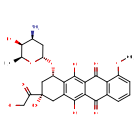
Doxorubicin is a medication used to treat various cancers, including AIDS-associated Kaposi's Sarcoma and metastatic cancers. Doxorubicin is a cytotoxic anthracycline antibiotic isolated from cultures of Streptomyces peucetius var. caesius along side with daunorubicin, another cytotoxic agent, in 1970.
- Mechanism
- Curator reviewed · 12 references
Generally, doxorubicin is thought to exert its antineoplastic activity through 2 primary mechanisms: intercalation into DNA and disrupt topoisomerase-mediated repairs and free radicals-mediated cellular damages.
Doxorubicin can intercalate into DNA through the anthraquinone ring, which stabilizes the complex by forming hydrogen bonds with DNA bases. Intercalation of doxorubicin can introduce torsional stress into the polynucleotide structure, thus destabilizing nucleosome structures and leading to nucleosome eviction and replacement. Additionally, the doxorubicin-DNA complex can interfere with topoisomerase II enzyme activity by preventing relegation of topoisomerase-mediated DNA breaks, thus inhibiting replication and transcription and inducing apoptosis.
Moreover, doxorubicin can be metabolized by microsomal NADPH-cytochrome P-450 reductase into a semiquinone radical, which can be reoxidized in the presence of oxygen to form oxygen radicals. Reactive oxygen species have been known to cause cellular damage through various mechanisms, including lipid peroxidation and membrane damage, DNA damage, oxidative stress, and apoptosis. Although free radicals generated from this pathway can be deactivated by catalase and superoxide dismutase, tumor and myocardial cells tend to lack these enzymes, thus explaining doxorubicin's effectiveness against cancer cells and tendency to cause cardiotoxicity.
- Primary indication
- Doxorubicin is indicated for the treatment of neoplastic conditions like acute lymphoblastic leukemia, acute myeloblastic leukemia, Hodgkin and non-Hodgkin lymphoma, metastatic breast cancer, metastatic Wilms’ tumor, metastatic neuroblastoma, metastatic soft tissue and bone sarcomas, metastatic...Curator reviewed · 29 structured indications
- Formula / weight
- C27H29NO11 · 543.5193 g/mol (avg)
- First approval
- Canada, 1997 · United States, 1987 · European Union, 2016
- Also known as
- 14-hydroxydaunomycin · 14-hydroxydaunorubicine · Doxorubicin nanoparticles · Hydroxydaunorubicin · Hydroxyl daunorubicin
- Code names
- FI-106 · NSC-123127 · TLC D-99
- Brand names
Resolves to
AOJJSUZBOXZQNB-TZSSRYMLSA-NSMILESCOC1=CC=CC2=C1C(=O)C1=C(O)C3=C(C[C@](O)(C[C@@H]3O[C@H]3C[C@H](N)[C@H](O)[C@H](C)O3)C(=O)CO)C(O)=C1C2=OWhat you can answer from here — as of September 23, 2026
Which drugs share a target with Doxorubicin, and which of those have an active Phase 3 trial?
Create a free account or log in to explore the full data card.
Create Account