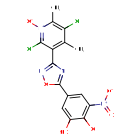
Opicapone is a catechol-O-methyltransferase inhibitor used as an adjunct treatment for Parkinson's Disease in adults currently receiving levodopa and a dopa decarboxylase inhibitor. Opicapone is a potent, reversible, and peripherally-acting third-generation inhibitor of catechol-o-methyltransferase (COMT), an enzyme involved in the breakdown of various catecholamines including dopamine.
- Mechanism
- Curator reviewed · 3 references
Levodopa (L-Dopa) is the gold standard for managing motor and some non-motor symptoms associated with Parkinson's Disease; however, only a small fraction of administered L-Dopa actually crosses the blood-brain barrier to exert its therapeutic action and patients face the risk of developing end-of-dose motor fluctuations, which reflects the rapid peripheral metabolism of L-dopa by aromatic L-amino acid decarboxylase and catechol-O-methyltransferase (COMT).
Opicapone is a peripheral, selective, and reversible catechol-O-methyltransferase (COMT) inhibitor. It displays a high binding affinity that is in sub-picomolar ranges, resulting in a slow complex dissociation rate constant and long duration of action in vivo. When opicapone is added to the treatment regimen that contains L-Dopa and DOPA decarboxylase inhibitor, opicapone helps to increase the plasma levels and enhance the therapeutic efficacy of L-Dopa.
- Primary indication
- Opicapone is indicated as adjunctive therapy in adults with Parkinson’s disease and end-of-dose motor fluctuations or “off” episodes whose symptoms cannot be stabilized on the combination therapy of levodopa and DOPA decarboxylase inhibitor (e.g., carbidopa).Curator reviewed · 2 structured indications
- Formula / weight
- C15H10Cl2N4O6 · 413.17 g/mol (avg)
- First approval
- United States, 2020 · European Union, 2016
- Code names
- BIA 9-1067
- Brand names
Resolves to
ASOADIZOVZTJSR-UHFFFAOYSA-NSMILESCC1=C(C2=NOC(=N2)C2=CC(=C(O)C(O)=C2)[N+]([O-])=O)C(Cl)=[N+]([O-])C(C)=C1ClWhat you can answer from here — as of June 15, 2026
Which drugs share a target with Opicapone, and which of those have an active Phase 3 trial?
Create a free account or log in to explore the full data card.
Create Account