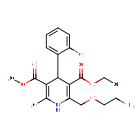
Amlodipine is a calcium channel blocker used to treat hypertension and angina. Amlodipine, initially approved by the FDA in 1987, is a popular antihypertensive drug belonging to the group of drugs called dihydropyridine calcium channel blockers.
- Mechanism
- Curator reviewed · 3 references
Mechanism of action on blood pressure
Amlodipine is considered a peripheral arterial vasodilator that exerts its action directly on vascular smooth muscle to lead to a reduction in peripheral vascular resistance, causing a decrease in blood pressure. Amlodipine is a dihydropyridine calcium antagonist (calcium ion antagonist or slow-channel blocker) that inhibits the influx of calcium ions into both vascular smooth muscle and cardiac muscle. Experimental studies imply that amlodipine binds to both dihydropyridine and nondihydropyridine binding sites, located on cell membranes. The contraction of cardiac muscle and vascular smooth muscle are dependent on the movement of extracellular calcium ions into these cells by specific ion channels. Amlodipine blocks calcium ion influx across cell membranes with selectivity. A stronger effect of amlodipine is exerted on vascular smooth muscle cells than on cardiac muscle cells. Direct actions of amlodipine on vascular smooth muscle result in reduced blood pressure.
Mechanism of action in angina
The exact mechanism by which amlodipine relieves the symptoms of angina have not been fully elucidated to this date, however, the mechanism of action is likely twofold:
Amlodipine has a dilating effect on peripheral arterioles, reducing the total peripheral resistance (afterload) against which the cardiac muscle functions. Since the heart rate remains stable during amlodipine administration, the reduced work of the heart reduces both myocardial energy use and oxygen requirements.
Dilatation of the main coronary arteries and coronary arterioles, both in healthy and ischemic areas, is another possible mechanism of amlodipine reduction of blood pressure. The dilatation causes an increase in myocardial oxygen delivery in patients experiencing coronary artery spasm (Prinzmetal's or variant angina) and reduces coronary vasoconstriction caused by smoking.
- Primary indication
- Amlodipine may be used alone or in combination with other antihypertensive and antianginal agents for the treatment of the following conditions: • Hypertension • Coronary artery disease • Chronic stable angina • Vasospastic angina (Prinzmetal’s...Curator reviewed · 19 structured indications
- Formula / weight
- C20H25ClN2O5 · 408.876 g/mol (avg)
- First approval
- Canada, 2006 · United States, 1992 · European Union, 2016
- Code names
- HGP0904
- Brand names
Resolves to
HTIQEAQVCYTUBX-UHFFFAOYSA-NSMILESCCOC(=O)C1=C(COCCN)NC(C)=C(C1C1=CC=CC=C1Cl)C(=O)OCWhat you can answer from here — as of October 16, 2026
Which drugs share a target with Amlodipine, and which of those have an active Phase 3 trial?
Create a free account or log in to explore the full data card.
Create Account