Cyclobenzaprine is a skeletal muscle relaxant that works on the brainstem to treat muscle spasms of local origin. Cyclobenzaprine, a centrally-acting muscle relaxant, was first synthesized in 1961 and has been available for human use since 1977.
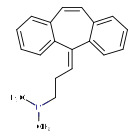
- Mechanism
- Curator reviewed · 6 references
The exact mechanism of action of cyclobenzaprine has not been fully elucidated in humans, and much of the information available regarding its mechanism has been ascertained from early animal studies. There is some evidence that cyclobenzaprine exerts its effects at the supraspinal level, specifically within the locus coeruleus of the brainstem, with little-to-no action at neuromuscular junctions or directly on skeletal musculature. Action on the brainstem is thought to result in diminished activity of efferent alpha and gamma motor neurons, likely mediated by inhibition of coeruleus-spinal or reticulospinal pathways, and ultimately depressed spinal cord interneuron activity.
More recently it has been suggested that inhibition of descending serotonergic pathways in the spinal cord via action on 5-HT2 receptors may contribute to cyclobenzaprine’s observed effects.
- Primary indication
- Cyclobenzaprine is indicated as short-term (2–3 weeks) adjunctive therapy, along with rest and physical therapy, for the relief of muscle spasm associated with acute, painful musculoskeletal conditions.Curator reviewed · 3 structured indications
- Formula / weight
- C20H21N · 275.3874 g/mol (avg)
- First approval
- Canada, 1997 · United States, 1977
- Code names
- MK-130 · TNX-102
- Brand names
Resolves to
JURKNVYFZMSNLP-UHFFFAOYSA-NSMILESCN(C)CCC=C1C2=CC=CC=C2C=CC2=CC=CC=C12What you can answer from here — as of September 23, 2026
Which drugs share a target with Cyclobenzaprine, and which of those have an active Phase 3 trial?
Create a free account or log in to explore the full data card.
Create Account