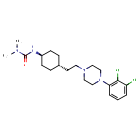
Cariprazine is an atypical antipsychotic used to treat schizophrenia and acute manic or mixed episodes due to bipolar I disorder. Cariprazine is an atypical antipsychotic agent and a piperazine derivative that was first developed in Hungary.
- Mechanism
- Curator reviewed · 9 references
While recent research points to the involvement of multiple neurotransmitters in the development and maintenance of schizophrenia and bipolar disorders, the dopamine hypothesis has been and continues to be a key theory in understanding the pathophysiology of these psychiatric disorders. Dopamine is a neurotransmitter that plays several important roles in cells, and most importantly, it is a crucial neurotransmitter involved in reward processing and motivation. The nigrostriatal, mesolimbic, and mesocortical systems consist of dopaminergic projections. The dopamine hypothesis states that dopaminergic aberrations are observed in schizophrenia and bipolar disorders. For example, hyperactive dopamine D2 receptor activity has been associated with positive symptoms of schizophrenia, such as hallucinations and delusions. On the other hand, alterations in dopamine D3 receptors may be involved in producing negative symptoms of schizophrenia. It was stated that hyperdopaminergia, caused by elevations in D2/3 receptor availability and a hyperactive reward processing network, underlies the development of mania in bipolar disorder.
The exact mechanism of action of cariprazine is not fully elucidated. Cariprazine potently binds to both of these receptors, more preferably to D3 receptors with higher affinity. Preclinical studies suggest that D3 receptor blockade is associated with exerting pro-cognitive and antidepressant effects and attenuating negative symptoms in schizophrenia. This unique mechanism of action differs from that of other antipsychotic agents that mostly target D2 and 5-HT2A receptors. Cariprazine is also a partial agonist at 5-HT1A receptors, an antagonist at 5-HT2B and 5-HT2A receptors, an antagonist at histamine H1 receptors. It also binds to 5-HT2C, alpha (α)-1A adrenergic, and alpha (α)-1B adrenergic receptors with low affinity.
- Primary indication
- Cariprazine is indicated for the treatment of schizophrenia in adults to manage both positive and negative symptoms.Curator reviewed · 3 structured indications
- Formula / weight
- C21H32Cl2N4O · 427.41 g/mol (avg)
- First approval
- Canada, 2022 · United States, 2015 · European Union, 2020
- Code names
- MP-214 · RGH-188
- Brand names
Resolves to
KPWSJANDNDDRMB-QAQDUYKDSA-NSMILESCN(C)C(=O)N[C@H]1CC[C@H](CCN2CCN(CC2)C2=C(Cl)C(Cl)=CC=C2)CC1What you can answer from here — as of September 23, 2026
Which drugs share a target with Cariprazine, and which of those have an active Phase 3 trial?
Create a free account or log in to explore the full data card.
Create Account