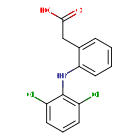
Diclofenac is an NSAID used to treat the signs and symptoms of osteoarthritis and rheumatoid arthritis. Diclofenac is a phenylacetic acid derivative and non-steroidal anti-inflammatory drug (NSAID).
- Mechanism
- Curator reviewed · 8 references
Diclofenac inhibits cyclooxygenase-1 and -2, the enzymes responsible for production of prostaglandin (PG) G2 which is the precursor to other PGs. These molecules have broad activity in pain and inflammation and the inhibition of their production is the common mechanism linking each effect of diclofenac.
PGE2 is the primary PG involved in modulation of nociception. It mediates peripheral sensitization through a variety of effects. PGE2 activates the Gq-coupled EP1 receptor leading to increased activity of the inositol trisphosphate/phospholipase C pathway. Activation of this pathway releases intracellular stores of calcium which directly reduces action potential threshold and activates protein kinase C (PKC) which contributes to several indirect mechanisms. PGE2 also activates the EP4 receptor, coupled to Gs, which activates the adenylyl cyclase/protein kinase A (AC/PKA) signaling pathway. PKA and PKC both contribute to the potentiation of transient receptor potential cation channel subfamily V member 1 (TRPV1) potentiation, which increases sensitivity to heat stimuli. They also activate tetrodotoxin-resistant sodium channels and inhibit inward potassium currents. PKA further contributes to the activation of the P2X3 purine receptor and sensitization of T-type calcium channels. The activation and sensitization of depolarizing ion channels and inhibition of inward potassium currents serve to reduce the intensity of stimulus necessary to generate action potentials in nociceptive sensory afferents. PGE2 act via EP3 to increase sensitivity to bradykinin and via EP2 to further increase heat sensitivity. Central sensitization occurs in the dorsal horn of the spinal cord and is mediated by the EP2 receptor which couples to Gs. Pre-synaptically, this receptor increases the release of pro-nociceptive neurotransmitters glutamate, CGRP, and substance P. Post-synaptically it increases the activity of AMPA and NMDA receptors and produces inhibition of inhibitory glycinergic neurons. Together these lead to a reduced threshold of activating, allowing low intensity stimuli to generate pain signals. PGI2 is known to play a role via its Gs-coupled IP receptor although the magnitude of its contribution varies. It has been proposed to be of greater importance in painful inflammatory conditions such as arthritis. By limiting sensitization, both peripheral and central, via these pathways NSAIDs can effectively reduce inflammatory pain.
PGI2 and PGE2 contribute to acute inflammation via their IP and EP2 receptors. Similarly to β adrenergic receptors these are Gs-coupled and mediate vasodilation through the AC/PKA pathway. PGE2 also contributes by increasing leukocyte adhesion to the endothelium and attracts the cells to the site of injury. PGD2 plays a role in the activation of endothelial cell release of cytokines through its DP1 receptor. PGI2 and PGE2 modulate T-helper cell activation and differentiation through IP, EP2, and EP4 receptors which is believed to be an important activity in the pathology of arthritic conditions. By limiting the production of these PGs at the site of injury, NSAIDs can reduce inflammation.
PGE2 can cross the blood-brain barrier and act on excitatory Gq EP3 receptors on thermoregulatory neurons in the hypothalamus. This activation triggers an increase in heat-generation and a reduction in heat-loss to produce a fever. NSAIDs prevent the generation of PGE2 thereby reducing the activity of these neurons.
- Primary indication
- Diclofenac is indicated for use in the treatment of pain and inflammation from varying sources including inflammatory conditions such as osteoarthritis, rheumatoid arthritis, and ankylosing spondylitis, as well as injury-related inflammation due to surgery and...Curator reviewed · 78 structured indications
- Formula / weight
- C14H11Cl2NO2 · 296.149 g/mol (avg)
- First approval
- Canada, 1997 · United States, 1988
- Also known as
- Diclofenac acid
- Code names
- ISV-205 · LAS41007
- Brand names
Resolves to
DCOPUUMXTXDBNB-UHFFFAOYSA-NSMILESOC(=O)CC1=CC=CC=C1NC1=C(Cl)C=CC=C1ClWhat you can answer from here — as of September 21, 2026
Which drugs share a target with Diclofenac, and which of those have an active Phase 3 trial?
Create a free account or log in to explore the full data card.
Create Account