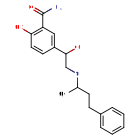
Labetalol is an alpha and beta adrenergic antagonist used to treat hypertension, angina, and sympathetic overactivity syndrome. Labetalol is a racemic mixture of 2 diastereoisomers where dilevalol, the R,R' stereoisomer, makes up 25% of the mixture.
- Mechanism
- Curator reviewed · 9 references
Labetalol non-selectively antagonizes beta-adrenergic receptors, and selectively antagonizes alpha-1-adrenergic receptors. Following oral administration, labetalol has 3 times the beta-blocking ability than alpha-blocking ability. This increases to 6.9 times following intravenous administration. Antagonism of alpha-1-adrenergic receptors leads to vasodilation and decreased vascular resistance. This leads to a decrease in blood pressure that is most pronounced while standing. Antagonism of beta-1-adrenergic receptors leads to a slight decrease in heart rate. Antagonism of beta-2-adrenergic receptors leads to some of the side effects of labetalol such as bronchospasms, however this may be slightly attenuated by alpha-1-adrenergic antagonism. Labetalol leads to sustained vasodilation over the long term without a significant decrease in cardiac output or stroke volume, and a minimal decrease in heart rate.
- Primary indication
- Labetalol injections are indicated to control blood pressure in severe hypertension.Curator reviewed · 7 structured indications
- Formula / weight
- C19H24N2O3 · 328.4055 g/mol (avg)
- First approval
- Canada, 2001 · United States, 1984
- Also known as
- Labetolol
- Brand names
Resolves to
SGUAFYQXFOLMHL-UHFFFAOYSA-NSMILESCC(CCC1=CC=CC=C1)NCC(O)C1=CC(C(N)=O)=C(O)C=C1What you can answer from here — as of September 23, 2026
Which drugs share a target with Labetalol, and which of those have an active Phase 3 trial?
Create a free account or log in to explore the full data card.
Create Account